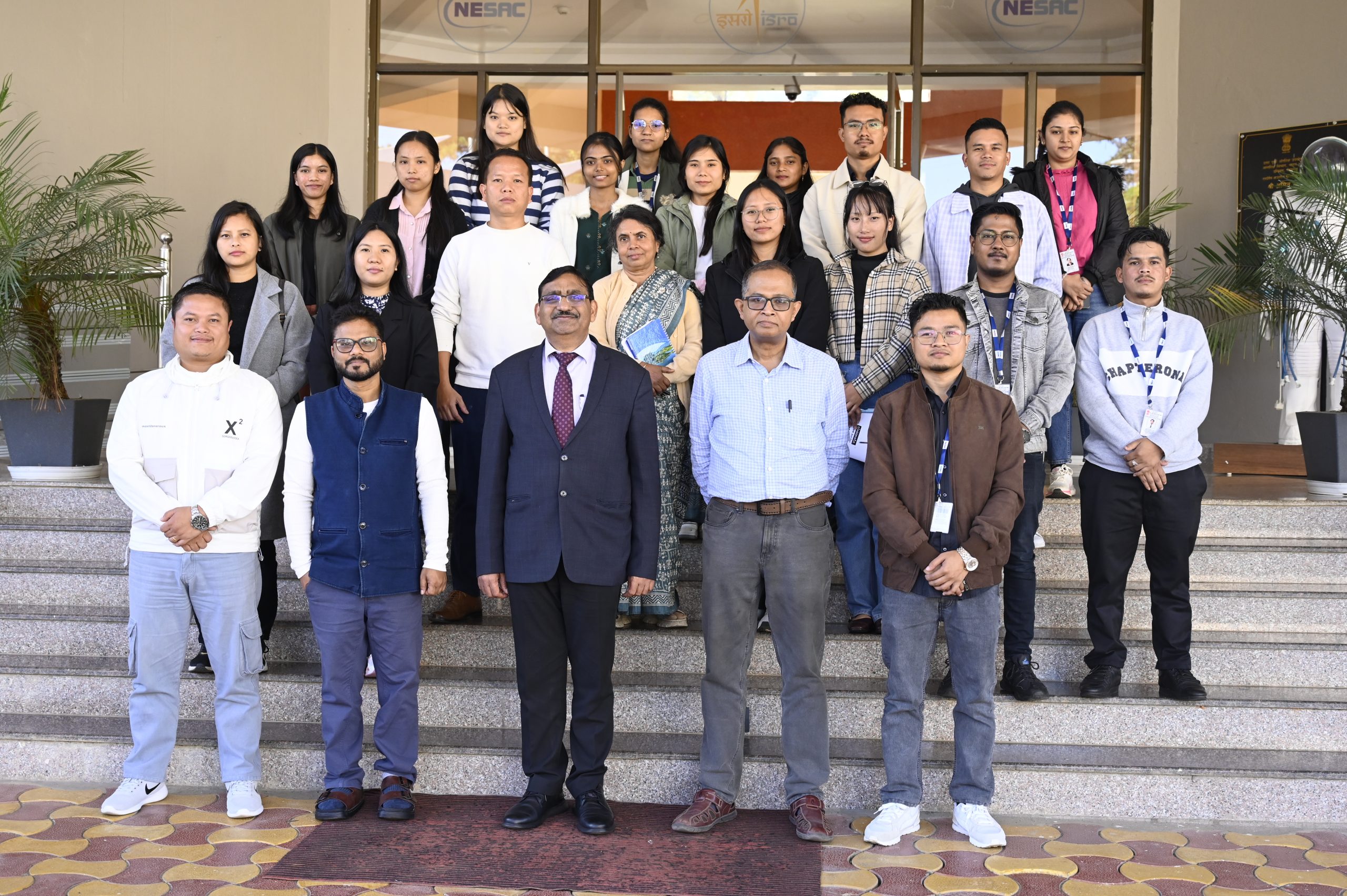
NESAC successfully conducted a two-week basic training course on “Applications of Remote Sensing and GIS in Water Resources and Flood Management” during November 10-21, 2025 at the NESAC Outreach Facility, Umiam. A total of 12 participants from government departments and academic institutions across different parts of India took part in the programme.
The inaugural session on November 10, 2025 began with a welcome address by Dr. Diganta Barman, Head, Water Resources Division (WRD), followed by an overview of the course by Shri Shanbor Kurbah, Scientist/Engineer–SD, WRD and Course Officer. Dr. K.K. Sarma, Group Head, Remote Sensing Applications Group (RSAG) and Deputy Director, North Eastern Regional Disaster Risk Reduction (NER-DRR), graced the occasion and highlighted the capabilities of space-based observations and geospatial technologies in addressing today’s water-related and disaster-risk challenges.
The course was designed with a clear technical progression from fundamentals to applications. It comprised 11 theory classes and 14 hands-on practical sessions, covering topics from basic to advanced levels such as basic of remote sensing and GIS, hydrological modeling, hydrodynamic modeling, Dam break modeling, flood management and basics of soil erosion estimation, Flood Early Warning System, Climate changes and its impact, LiDAR and microwave remote sensing. The practical sessions emphasized complete technical workflows starting from satellite and ancillary data ingestion, DEM processing and watershed delineation, to model setup, calibration concepts (where possible) and generation of flood inundation and support maps that can feed into early warning and decision-support systems.
A special lecture was taken by Director, NESAC, on “Space technology in climate change and disaster management”, which emphasized the importance of space technology at present and future in better understanding of the current trend of Climate and disaster related phenomena.
The course concluded with the valedictory program held on November 21, 2025. Shri Shanbor Kurbah, Course Officer, welcomed all the participants and summarized the two-week course. Dr. S.P. Aggarwal, Director, NESAC, addressed the participants, inspired and encouraged all to use these powerful technologies for their developmental planning and governance. The program was concluded with a vote of thanks offered by Shri. Ranjit Das, Scientist/Engineer SF.