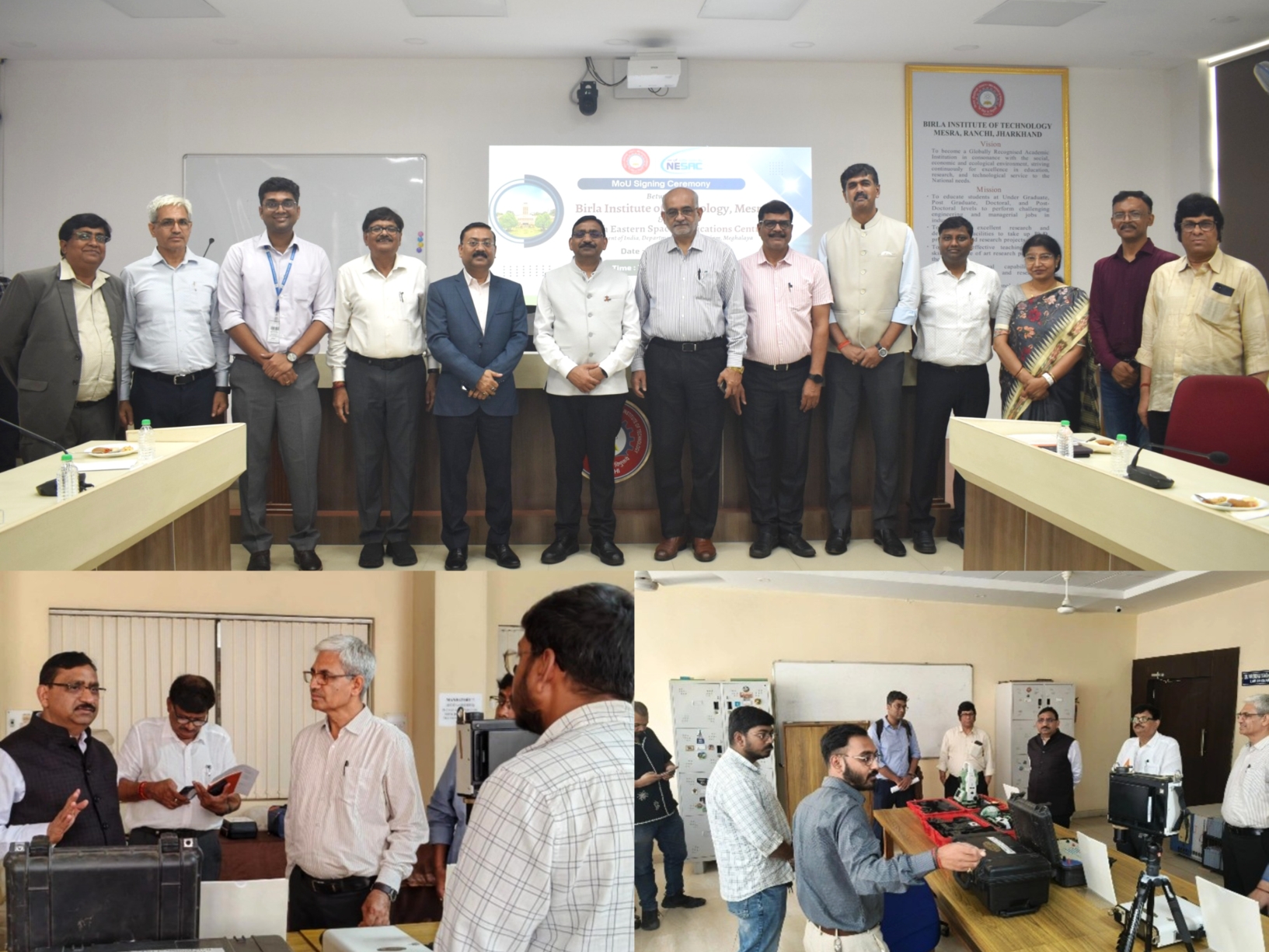
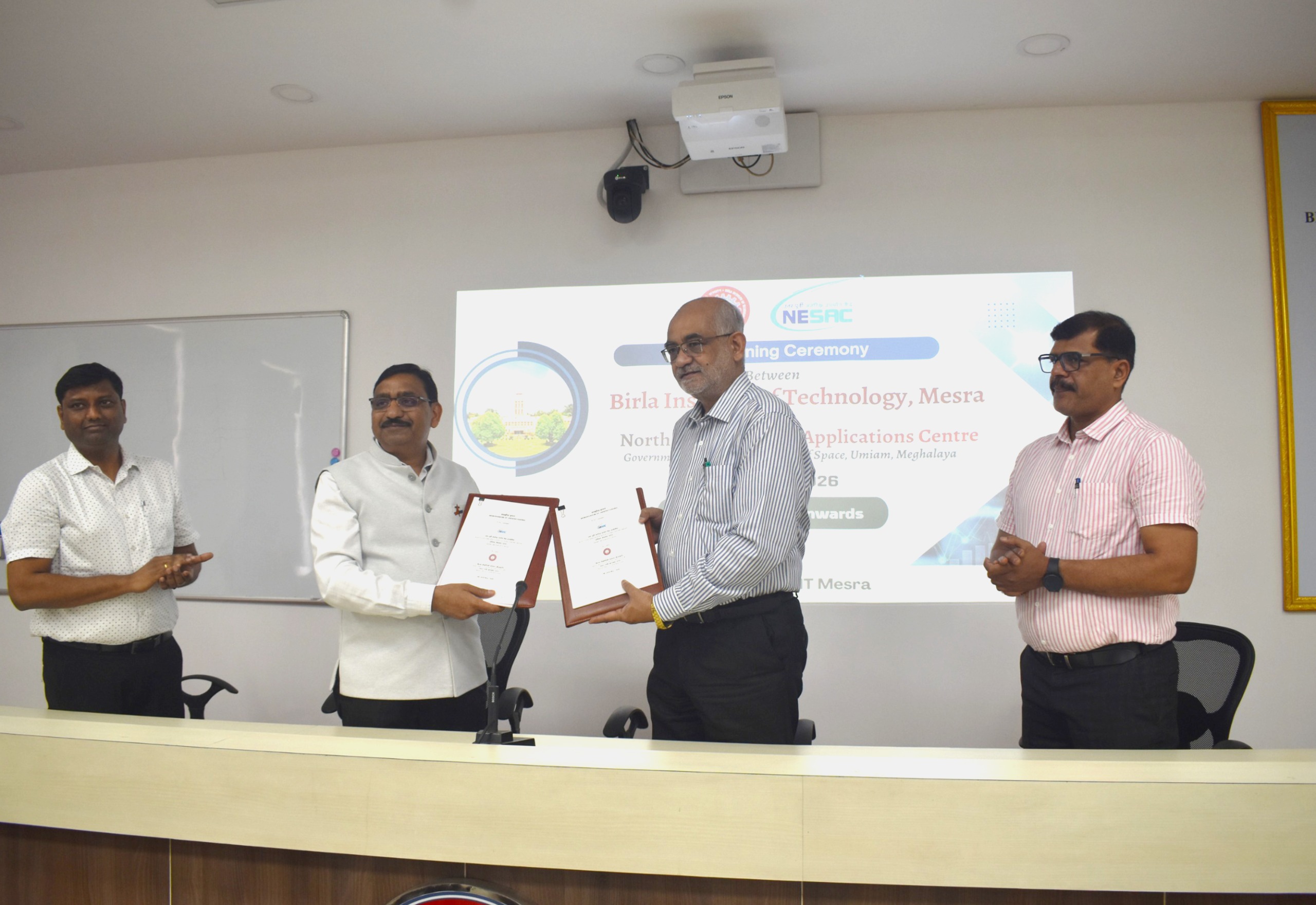
North Eastern Space Applications Centre and Birla Institute of Technology Mesra signed a Memorandum of Understanding (MoU) on 19 May 2026 at the BIT Mesra campus, Ranchi, to strengthen collaboration in the domains of Geospatial Artificial Intelligence (GeoAI), Remote Sensing, Geographic Information Systems (GIS), Artificial Intelligence (AI), and Advanced Geospatial Technologies.
The MoU was signed by Dr. S. P. Aggarwal, Director NESAC and Prof. Indranil Manna, VC BIT Mesra. The programme was attended by Dr. C. Jeganathan, VC Sarla Birla University and former Dean of Research, Innovation & Extension (DRIE), along with Deans, faculty members, researchers, and officials of BIT Mesra, as well as scientist from NESAC.
The collaboration envisions joint research projects in GeoAI and advanced geospatial technologies, co-supervision of Master’s and PhD scholars, organization of seminars, workshops, and training programmes, guest faculty engagement, and capacity-building initiatives in Remote Sensing, GIS, Space Technology, and interdisciplinary geospatial applications.
The programme commenced with a welcome address by Prof. A. P. Krishna, who highlighted the growing importance of collaborative research and innovation in emerging geospatial technologies. Dr. Rajesh Jain also addressed the gathering and emphasized the institutional vision behind the partnership. A detailed presentation on the objectives and scope of the MoU was delivered by Shri Nilay Nishant, Scientist-SE, NESAC.
Addressing the gathering, Director, NESAC emphasized the importance of MoU between BIT Mesra and NESAC and noted that the combined strengths of both institutions can significantly contribute towards research excellence, technological innovation, and societal applications in geospatial sciences.
Vice Chancellor, BIT Mesra highlighted that the collaboration holds immense potential for impactful research outcomes, high-quality publications, and stronger academic engagement among scientists, faculty members, researchers, and students of both institutions.
The programme concluded with closing remarks by Dr. S. S. Solanki, followed by a vote of thanks delivered by Shri Nilay Nishant.
Director, NESAC also visited various laboratories and research facilities of BIT Mesra and interacted with faculty members, researchers and students of the institute. Discussions were held on potential collaborative research activities in GeoAI, Earth Observation, geospatial systems, and emerging space applications.